THREAT MODELING
The Adversary Has Already Mapped Your Environment. Have You?
Every sophisticated adversary begins their operation the same way — with reconnaissance. They study the target environment, identify the trust boundaries, locate the high-value assets, and map the approach routes that the defensive program has not covered. The reconnaissance phase is patient, methodical, and entirely invisible to a detection program focused on the techniques that follow it. By the time the first alert fires, the adversary already knows more about your environment than your threat model does.
Environment and TTP Mapping
Every Gap Identified. Every Gap Owned. Every Gap on a Path to Closure.
Every Gap Routed to the Pillar That Closes It — Automatically
EVERY GAP BEGINS WITH A MAP
The blueprint that every Security Operation Center needs.
Know your exposure
EXCLUSIVE
The Threat Model Starts Here
Every sophisticated adversary begins their operation with reconnaissance. They identify the target organization, study its public-facing infrastructure, map the internal architecture they can infer from job postings, technical documentation, and vendor relationships, and identify the trust boundaries and high-value assets that represent the path of least resistance to their objective. The reconnaissance phase is patient, methodical, and entirely invisible to a detection program focused on the techniques that follow it.
By the time the first alert fires, the adversary already knows more about your environment than your threat model does.
Most security organizations conduct some form of threat modeling — periodic exercises that produce detailed findings documents, gap registers, and remediation recommendations. Most of those documents have three things in common. They are not connected to current threat intelligence about the specific actors most likely to exploit the gaps they identify. They are not connected to the detection engineering program that should be closing the detection gaps they document. And they exist as a point-in-time assessment that ages from the moment it is produced — becoming less accurate with every architectural change, every new vendor integration, and every new technique the relevant threat actors add to their arsenal.
The threat model that was accurate eighteen months ago may dramatically understate your current exposure if you have migrated workloads to the cloud, added a dozen SaaS integrations, or if the threat actors targeting your industry have significantly expanded their technique repertoire since the last exercise. And the gaps it identified at the time of production are almost certainly still open — because there was no structured mechanism to connect those gaps to the operational programs that would close them.
TIME was built to solve every one of those problems.
A CLOSER LOOK
The Architect Who Studied the Terrain Before Drawing a Single Line
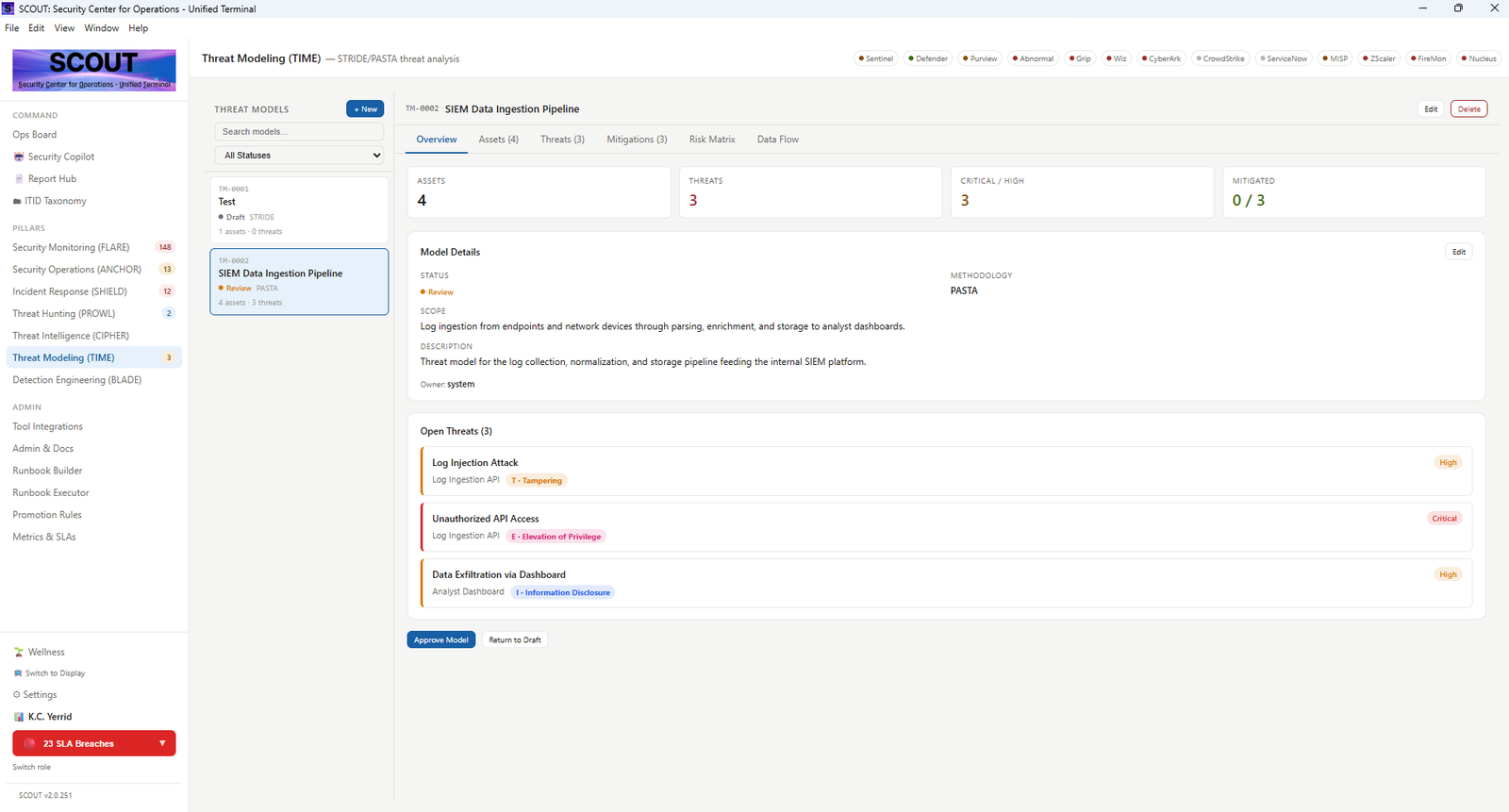
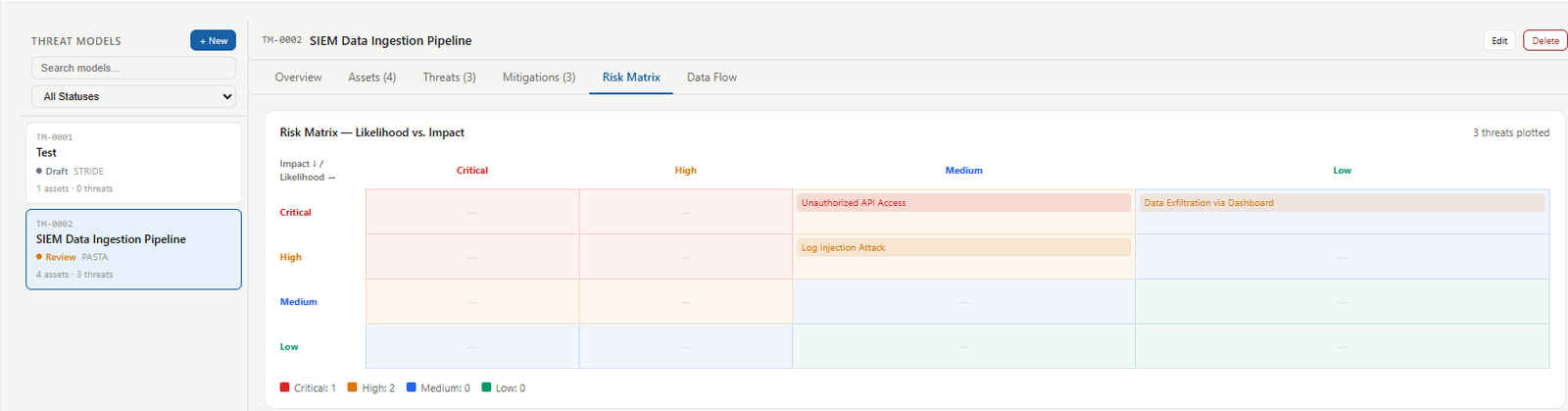
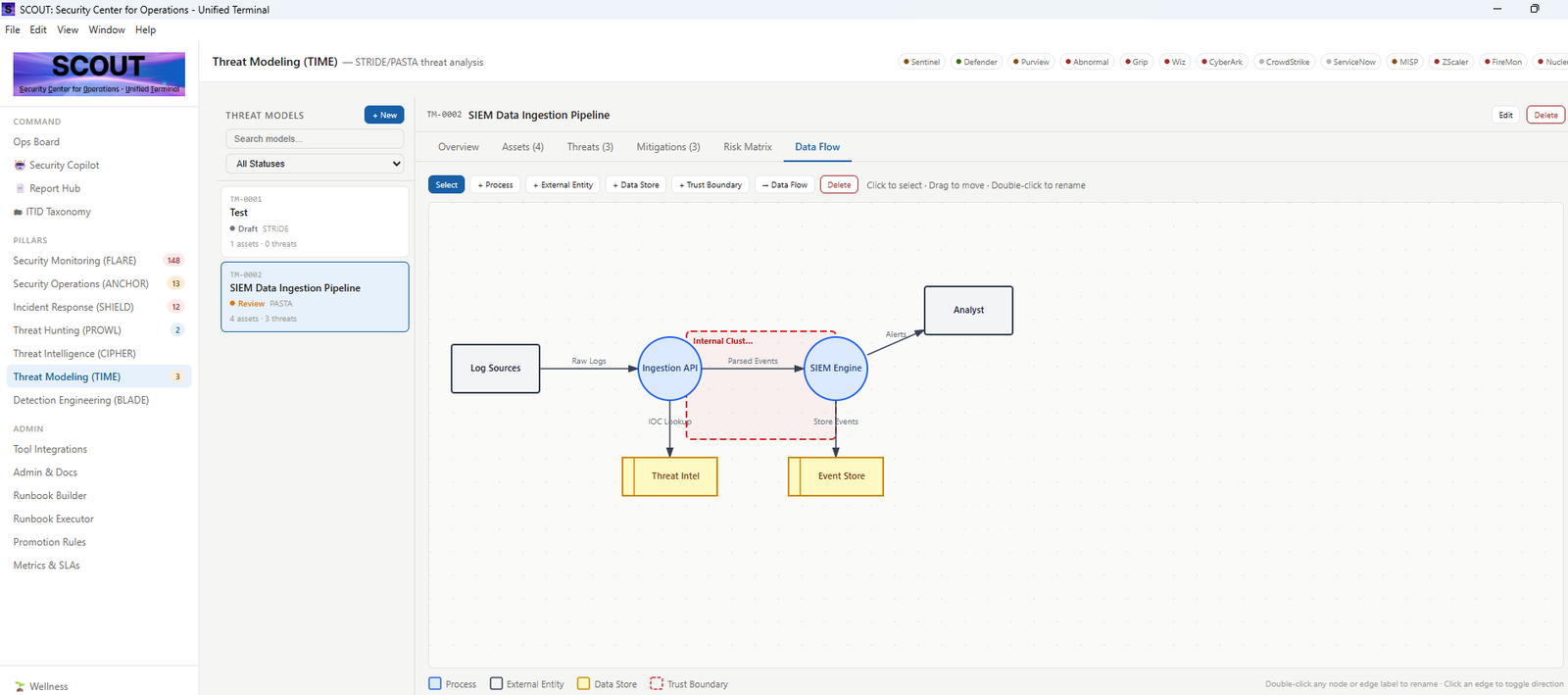
The geologist reads the fault line before the earthquake — not after. Every measurement taken, every pressure point assessed, every structural weakness mapped against the forces most likely to be applied to it. Every screenshot here shows TIME operating on that same principle — mapping your organizational architecture against the specific TTPs of your most relevant threat actors, identifying every fault line where adversary capability meets defensive gap, and routing each finding to the pillar that closes it before the pressure arrives. This is what it looks like to read the fault line while the structure is still standing.
TIME - THREAR INTELLIGENCE MODELING ENGINE
The Threat Model That Drives Every Defensive Decision Your SOC Makes
Map your architecture against your most relevant threat actors. Find every gap. Drive the work that closes it — automatically.
Environment and TTP Mapping
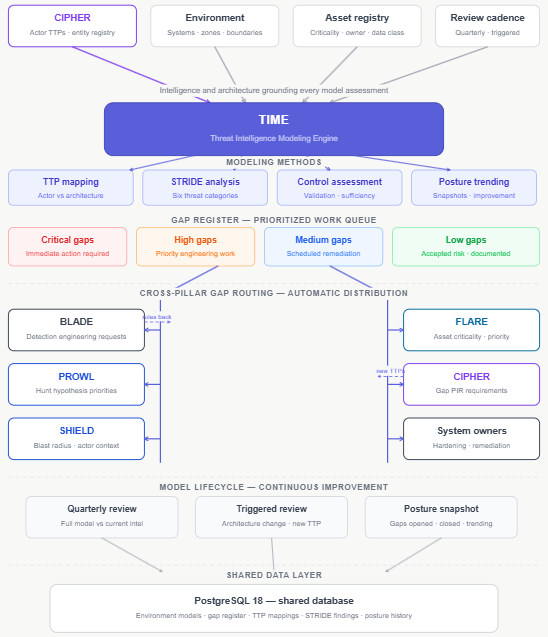
Every system, every network zone, every trust boundary, and every high-value asset documented — then mapped against the specific TTPs of the threat actors CIPHER has identified as most relevant. The gaps that emerge are not industry averages. They are the specific points where this adversary meets this organization's current defensive posture.
Gap Register and Prioritization
Every unmitigated threat and every undetected TTP becomes a discrete gap entry — severity rated Critical through Low, assigned to an owner with a remediation deadline, and connected directly to the BLADE request or PROWL hypothesis that closes it. The gap register is not a document. It is a prioritized work queue.
STRIDE Analysis
STRIDE analysis applies six structured threat categories — Spoofing, Tampering, Repudiation, Information Disclosure, Denial of Service, and Elevation of Privilege — to every component and every trust boundary in the environment model. The structural threats inherent to the architecture are identified regardless of which specific actor might exploit them.
Cross-Pillar Gap Routing
Detection gaps route to BLADE as structured engineering requests. Hunting priorities route to PROWL as hypothesis starting points. Asset criticality routes to FLARE as alert priority context. Hardening findings route to system owners with tracked deadlines. TIME does not describe the gap. It drives the work that closes it.
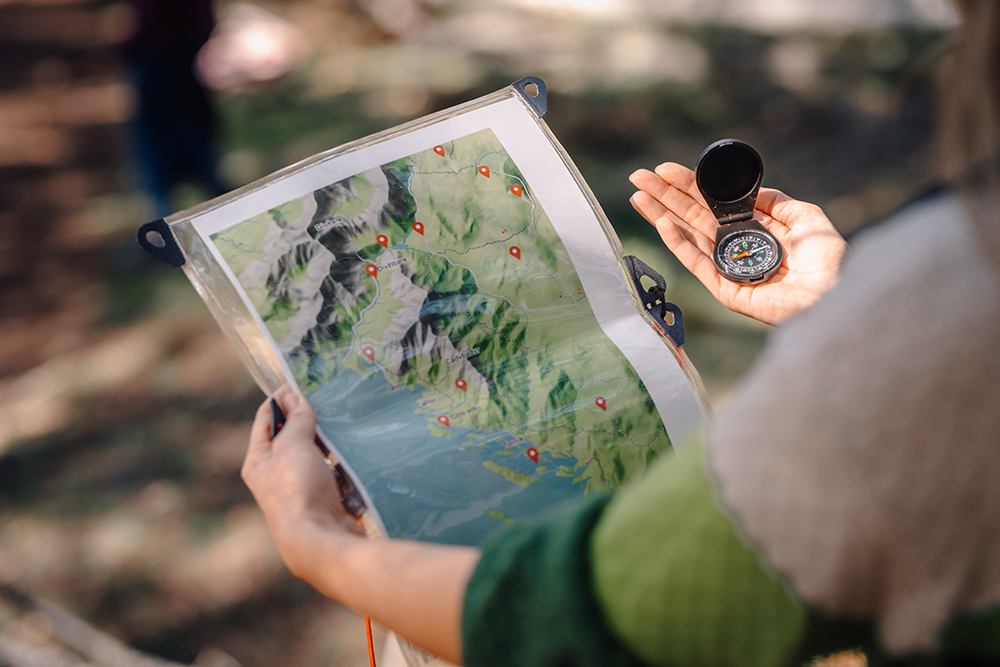
THE DEFENDER WHO KNOWS THE TERRAIN BEFORE THE ADVERSARY ARRIVES NEVER FIGHTS BLIND
The Map Is the Advantage
MODEL THE THREAT BEFORE THE ADVERSARY MODELS YOUR ENVIRONMENT
The Blueprint Before the Build
PILLAR FEATURES - PROBLEMS TIME SOLVES
Every Gap Begins With a Map
The cartographer who mapped an unknown territory did not produce a document — they produced a capability. Every subsequent navigator who relied on that map moved through the territory with confidence rather than guesswork. TIME produces the same capability for your security program — the map of where your environment is exposed, where the adversary's known techniques can find purchase, and where every defensive gap needs to be closed before the territory is entered.
The threat model that lived in a document
The exposure nobody calculated
The trust boundary nobody mapped
VERIFIED REVIEWS
The Blueprint That Shows Where Every Wall Is Thin
The military architect does not commit to a defensive design without first studying every approach route, every trust boundary, and every point where the architecture is thinner than the threat it will face. Schedule a free consultation and let us show you exactly where your defensive posture has gaps, which threat actors are most relevant to your specific environment, and what the TIME gap register looks like when every finding is connected to the pillar that closes it. One conversation. The complete terrain map.

K.C. Yerrid
"I built TIME because I spent years working in environments where the organization's threat model was less detailed than the adversary's reconnaissance. The adversary who targets a specific organization invests significant effort in understanding that environment before they execute a single technique. They know which trust boundaries exist. They know which high-value assets are connected to which systems. They know which detection rules exist and which techniques fall below the detection threshold. The defense program that has never formally conducted that same assessment — from the defensive side — is operating with a fundamental intelligence disadvantage. TIME closes that disadvantage. The environment model that maps every trust boundary, every high-value asset, and every data flow. The TTP mapping that assesses every relevant actor technique against every relevant architectural component. The gap register that makes every point where the adversary's capability meets the defense program's limitations explicit, prioritized, and connected to the operational work that closes it. The adversary already has a model of your environment. TIME gives your defense program the same capability — and then drives the work that makes the model increasingly difficult to exploit."
