INCIDENT RESPONSE
When the Perimeter Fails, the Response Begins Here
Every security architecture is designed to keep the threat outside the perimeter. Firewalls, endpoint protection, email filtering, identity controls — layers of defense built to stop the attack before it reaches what matters. And every experienced security professional knows that despite every one of those layers, the breach happens. The adversary finds the misconfiguration, exploits the zero-day, or social engineers the credential that no technical control was going to stop. The question is never whether the shield will be tested. The question is what happens the moment it is.
When the Breach Fires — the Runbook Is Already Open
The Incident Timeline That Builds Itself While Your Team Fights the Threat
Every Breach Hardens the Shield That Faces the Next One
THE LAST LINE IS NOT THE FIREWALL
The Breach Is Not the Failure. The Response Is. SHIELD Changes That.
The breach is not the failure. The response is.
EXCLUSIVE
The Problem SHIELD Was Built to Solve
When a security incident is confirmed, three things need to happen simultaneously — and in most Security Operations Centers, none of them happen as well as they should.
The response needs to be structured. Someone needs to know what to do first, what comes next, and what cannot be skipped regardless of the time pressure. Most response programs rely on runbooks that live in shared drives that nobody can find quickly, maintained by whoever last touched them, consulted inconsistently under pressure, and bypassed entirely when things move fast enough that there is no time to look anything up.
The response needs to be documented. Every action taken, every stakeholder notified, every piece of evidence collected needs to be recorded with enough precision and attribution to satisfy a compliance audit, a regulatory inquiry, or a legal discovery request that may arrive years after the incident closed. Most response programs rely on a combination of a shared document, a chat thread, and whoever has time to write things down — which is rarely anyone, because the people with the most relevant information are the people most actively engaged in the response.
The response needs to improve the program. Every incident contains information about what worked, what failed, what gap the adversary exploited, and what needs to change before the next incident. Most response programs produce a post-incident report that describes those findings, assigns them to nobody in particular, and files them somewhere they are never referenced again. The gap the adversary exploited stays open because nobody owns the remediation and nobody tracks it to closure.
SHIELD addresses all three problems with a single platform.
The runbook surfaces automatically at incident declaration — matched to the incident type and severity, with every required step enforced and every completion timestamped. The incident timeline builds automatically as the response progresses — every action attributed, every notification logged, every evidence attachment stored with full chain of custody. And the post-incident review initiates automatically at closure — every finding documented with an owner and a deadline, every remediation tracked, and a Post-Incident Report generated from the structured data SHIELD collected throughout the response.
The result is a response program that works the same way regardless of which analyst is running the incident, which shift it fires on, or how many simultaneous incidents are active. The structure is in the platform — which means it is available every time, not just when the most experienced person in the room happens to be running the response.
A CLOSER LOOK
Pull Back the Shield. See What Is Behind It.
A shield is only as strong as the system behind the analyst holding it. SHIELD gives every incident responder a structured response framework, a self-building incident timeline, enforced runbook execution, and a post-incident review that hardens the defense before the next engagement begins. Every capability examined in depth below — so you know exactly what the shield is made of before you raise it.
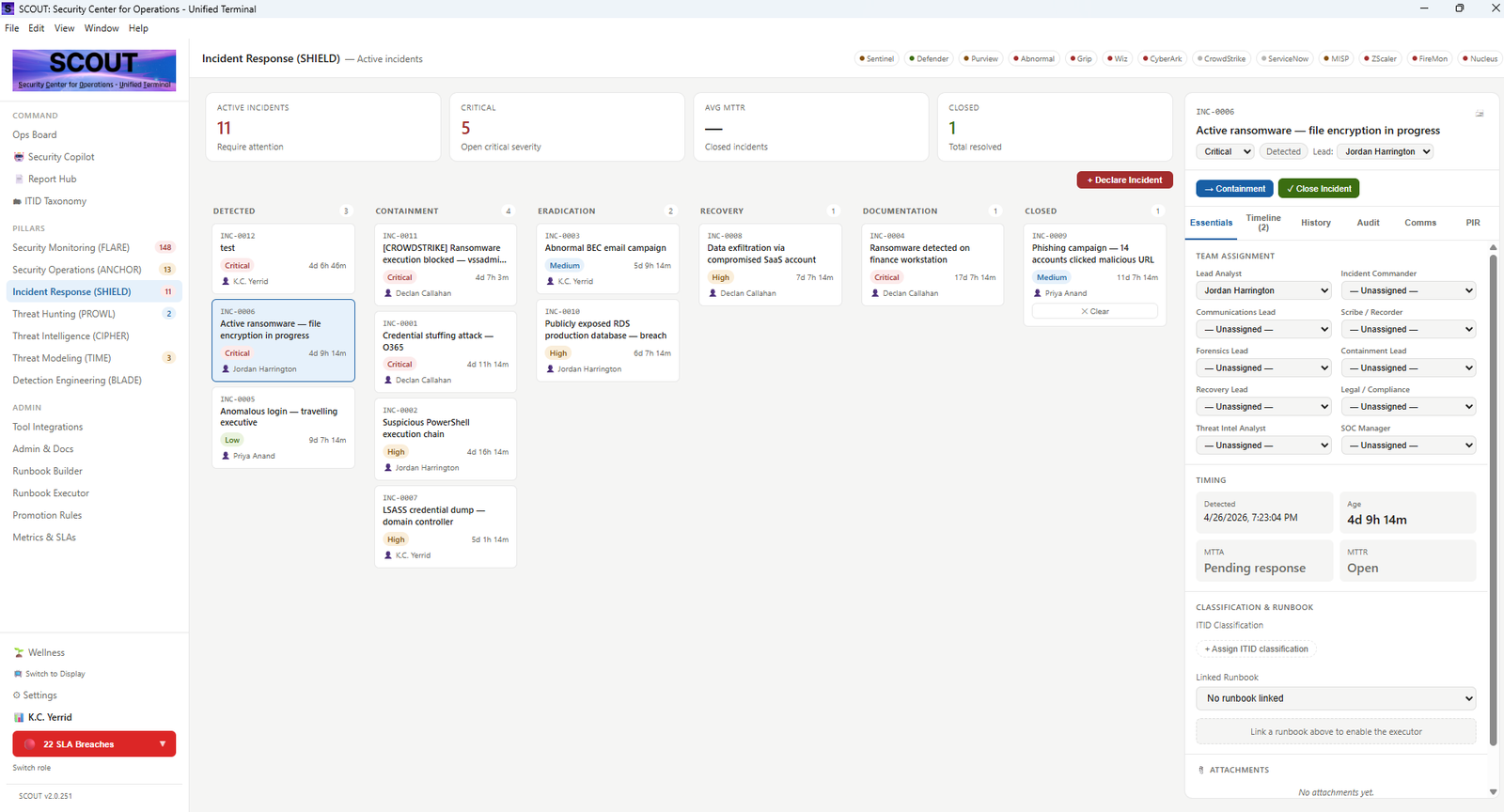
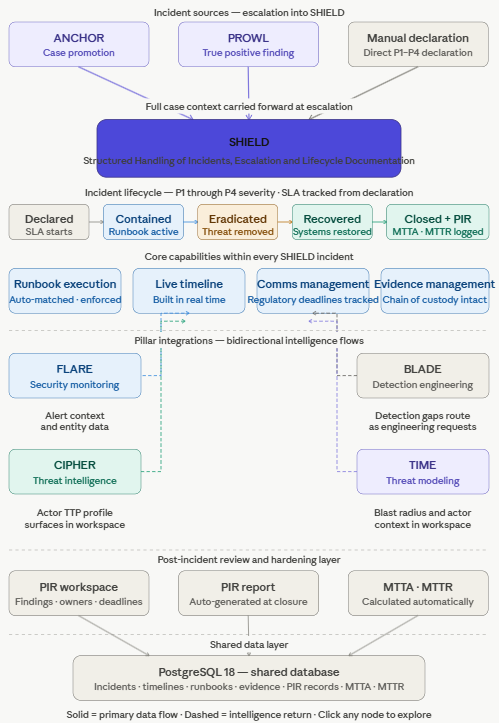
SHIELD - STRUCTURED HANDLING OF INCIDENTS, ESCALATION, AND LIFECYCLE DOCUMENTATION
Hold the Line. Document the Fight. Close the Incident.
Every Incident Contained. Every Response Documented. Every Gap Closed.
MTTA / MTTR Metrics
Mean Time to Acknowledge and Mean Time to Respond are calculated automatically at incident closure — derived from the timestamps SHIELD recorded as the response happened. No manual calculation. No spreadsheet. Accurate data every time.
Live Incident Timeline
Post-incident reconstruction from Slack messages and analyst memory is not documentation — it is historical fiction. SHIELD builds the complete, attributed, timestamped incident timeline in real time as every response action is taken — before the incident is closed.
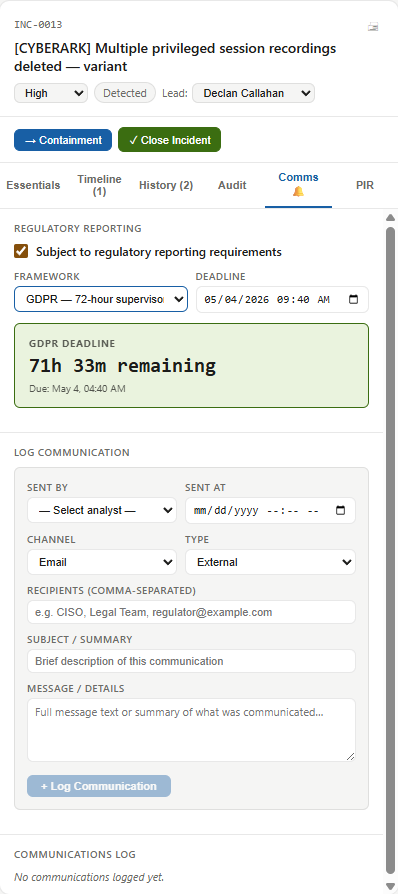
Stakeholder Communications
Regulatory notification deadlines run from the moment the incident is declared. SHIELD tracks every stakeholder communication — recipient, content, timestamp, sender — and keeps the deadline visible to the Communications Lead throughout the response.
Multi-Analyst Coordination
SHIELD assigns Technical Lead, Communications Lead, and supporting analyst roles at declaration — visible to every team member in the response workspace. No coordination happening outside the platform. No action taken without a record.

FORGED IN EVERY INCIDENT IT SURVIVES
The shield that learns from every strike it deflects.

THE DEFENSE GETS STRONGER
Every incident closed makes the next response more precise.
PILLAR FEATURES - PROBLEMS SHIELD SOLVES
The gaps between your tools are where threats live
Every disconnected dashboard, every ungoverned queue, every silent tool is an opening your adversary can exploit. FLARE was built to close every one of them — before the clock runs out.
The skipped step
The undocumented decision
The repeated incident
DOCUMENT THE FIGHT
The Shield Is Raised. Is Your Response?
The battle begins the moment the incident is declared. Whether your response wins or loses is determined in the minutes that follow — by how fast the runbook deploys, how completely the timeline builds, how clearly the team knows its role, and how thoroughly the post-incident review closes every gap the adversary found. SHIELD structures every one of those minutes. Schedule a free consultation and see exactly what that structure looks like in your environment.

K.C. Yerrid
When I set out to build SHIELD I started with a simple question — why does the quality of an incident response vary so dramatically from one analyst to the next, one shift to the next, one incident to the next, when the methodology for handling those incidents is well understood and well documented?
The answer I kept coming back to was structure. Not the absence of knowledge — most of the analysts I have worked alongside knew exactly what a good incident response looked like. The absence of a platform that enforced the structure those analysts already understood, at the moment of maximum pressure, when the adversary was still moving and the clock was running and the temptation to skip steps and improvise sequences was at its highest.
I have worked incidents where required containment steps were skipped because urgency overrode methodology. I have worked incidents where the timeline was reconstructed from memory three days after closure and bore no resemblance to what actually happened. I have worked incidents where the post-incident review identified seven distinct findings, none of which had an owner, none of which were tracked, and all of which were still open when the next incident confirmed the same gaps six months later.
Every one of those failures had a structural cause. And structural causes have structural solutions.
SHIELD was designed around three governing principles. First — the quality of the response should never depend on the experience of the individual running it. The structure should be in the platform. Second — documentation should be the byproduct of a structured response, not a separate effort that happens after the incident closes. Third — every incident should leave the program harder to breach than it was before — not through aspiration but through a post-incident review process that assigns ownership, tracks remediation, and verifies closure.
The adversary who breaches your perimeter is counting on disorder. They have studied your defenses and identified the window between initial compromise and organized response as the time when they can establish persistence, move laterally, and reach what they came for. SHIELD was built to close that window — not by making analysts faster or more experienced, but by making the structure so immediate and so complete that the window barely exists.
That is the philosophy. Every design decision in SHIELD traces back to it.”
