SECURITY OPERATIONS
Every Move Recorded. Every Thread Preserved.
The grandmaster who abandons a game mid-position does not erase the board. The notation exists. Every move is recorded. The next player who sits down inherits the complete game — not a summary, not a reconstruction from memory, not the version the outgoing player remembered to write down before they left.
Most SOC case management does not work that way. Notes live in someone’s head. Context disappears at shift change. The next analyst starts from wherever the last one remembered to document — which is rarely the furthest point forward. ANCHOR changes the standard. Every case has a complete notation. Every analyst inherits the full game.
The Note That Survives the Shift Change.
Every Case Has a Clock. Every Clock Is Visible.
One Action. The Complete Record. Zero Lost Context.
EVERY MOVE. EVERY GAME. EVERY RECORD.
The Signal Layer That Changes Everything After It
Every Signal. Every Source. One Picture.
EXCLUSIVE
The alert chaos ends here.
Most SOCs don’t have a visibility problem. They have a fragmentation problem. Alerts scattered across a dozen tools, each with its own interface, its own severity scale, and its own queue. FLARE ends that — one feed, one workspace, one prioritized picture of your threat landscape in real time.
The business cost of fragmentation is rarely measured directly — which is precisely why it persists. It does not appear on an invoice. It does not surface in a quarterly review. It accumulates silently in the form of analyst time spent reconstructing context that should already be unified, critical alerts worked late because they were buried under lower-priority noise, and source tools that go silent for hours before anyone notices the feed has stopped.
Each of those costs is individually manageable. Collectively they represent a structural drag on the security program’s ability to perform the function it exists to perform — catching threats before they become incidents.
FLARE addresses the structure. Not by adding another tool to the stack but by providing the unified layer the stack should have had from the beginning. Every source tool continues to do what it does. Every detection rule continues to fire. Every alert continues to be generated. FLARE simply ensures that all of it arrives in one place, in one language, in the right order — so that the investment the organization has already made in detection tooling performs the way leadership assumed it was performing when the contracts were signed.
One feed. One workspace. The visibility the organization was paying for all along.
A CLOSER LOOK
Every Move Your Analysts Make — Documented Before They Leave the Board
The shift change is where investigations go to drift.
Not because the analyst who hands off does anything wrong. Because most case management platforms give them nowhere to drop anchor before they leave. The notes live in a personal document. The context lives in a chat thread. The evidence lives in a downloads folder. And the analyst who picks it up next sails from whatever survived the handoff — which is rarely enough to hold a true heading.
ANCHOR changes the standard.
In maritime navigation, the ship’s log is what makes every voyage permanent. Every heading recorded. Every position fixed. Every depth sounding logged at the moment it was taken. Without it, even the most experienced navigator leaves no trace the next watch officer can follow. A voyage with no log is a voyage that happened only in the memory of the crew who sailed it — and memory does not survive a change of watch.
ANCHOR is the ship’s log of your security operations program — the workspace where every investigative heading is recorded the moment it is set, every piece of evidence is secured in the hold with full chain of custody, and every case builds the navigational chart the next investigation depends on to find its position.
Cases arrive from FLARE pre-populated — the vessel fully provisioned before the investigation leaves port. Notes are logged at the moment of writing — no detail left to memory, no observation trusted to recollection. SLA clocks start at case creation — the voyage timer running from the moment the anchor is raised. The complete record promotes to SHIELD in one action — the full ship’s log transferred to the next watch without a single page missing. And the immutable audit trail captures everything — so when the compliance review arrives, the evidence of a structured, documented, defensible voyage is already in the log.
Every heading recorded. Every position fixed. Every investigation permanent.
The shift change that does not lose the heading starts here.
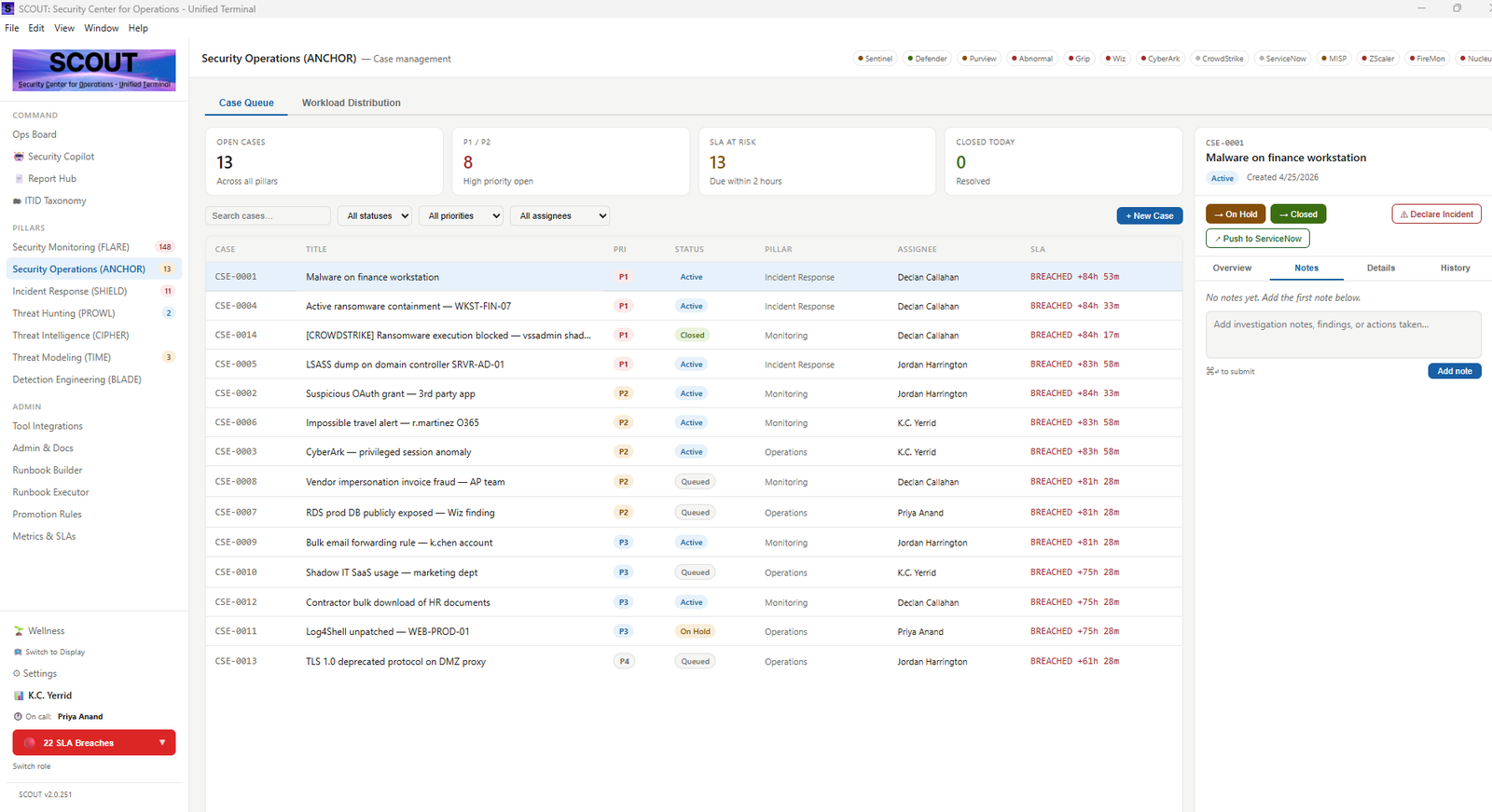
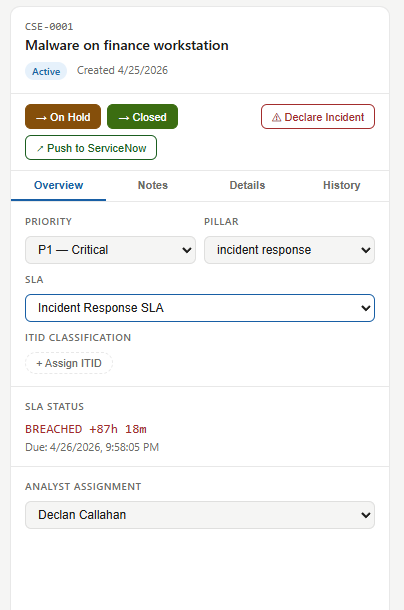
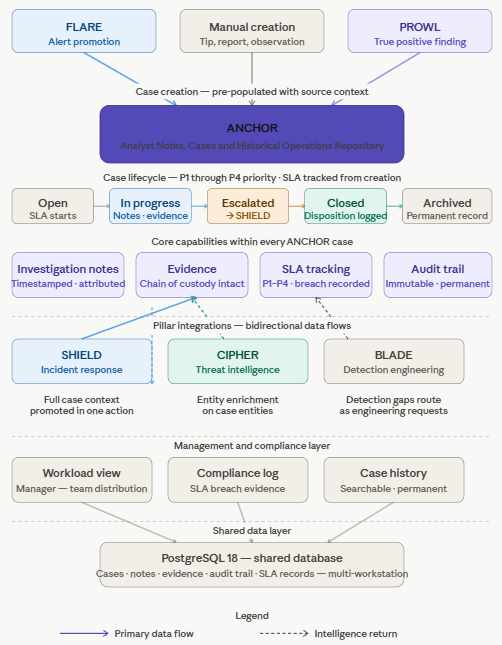
ANCHOR - ANALYST NOTES, CASES, AND HISTORICAL OPERATIONS REPOSITORY
No Dead Zones. No Dark Waters. Every Signal Surfaced and Ranked.
Infinite source tools. One normalized queue. Every alert enriched, prioritized, and connected to the workflows that act on it next.
The note that survives the shift change
Timestamped, attributed investigation notes written directly on the case. The analyst who picks this up at 3AM starts from the furthest point forward — not from wherever the last analyst remembered to document.
Team workload visible at a glance
Managers see the full case load distribution across the team — open cases per analyst, priority breakdown, and SLA health — without asking anyone for a status update.
Evidence that never leaves the record
Every attachment is timestamped, attributed, and stored with the case permanently. Chain of custody intact from the first screenshot to the final audit — regardless of how long the investigation runs.
One action. The complete record. Zero lost context.
ANCHOR promotes the complete case to SHIELD in a single action — every note, every attachment, every linked alert carried forward automatically. What the investigation built, the response team inherits.

STEADY AS SHE GOES
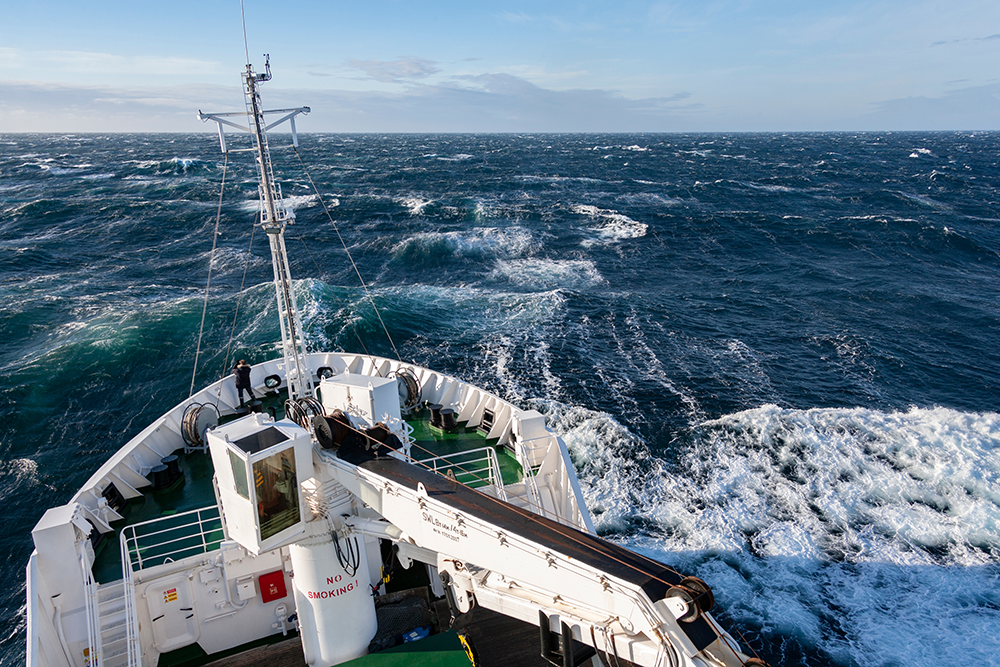
No drift. No lost bearings. No starting over.
ALL HANDS ON DECK
Every analyst. Every case. Every SLA.
PILLAR FEATURES - PROBLEMS ANCHOR SOLVES
Your Best Analysts Know Every One of These Problems. They Just Stopped Mentioning Them.
Every disconnected dashboard, every ungoverned queue, every silent tool is an opening your adversary can exploit. FLARE was built to close every one of them — before the clock runs out.
The invisible handoff
The timeline assembled from memory
The forensic artifact in a downloads folder
CHART THE COURSE
The Navigator Who Knows Their Position Commands Every Sea They Sail
The tide does not wait for the captain who is still reviewing the old charts. Every shift change your team runs without a structured case record is another watch where institutional knowledge drifts a little further from where it needs to be. Every SLA breach that goes unrecorded is another gap in the log the compliance review will eventually find. A free ANCHOR consultation shows you what closing those gaps looks like — specifically, in your environment, for your team size, against your current workflow. Thirty minutes. No obligation. The chart your investigation program has been missing.

K.C. Yerrid
"I built ANCHOR because I watched too many investigations lose their thread at shift change — not because the analyst failed, but because the platform gave them nowhere to put the work. That problem has a solution. It just required someone to build it into the platform rather than leaving it as an exercise for the analyst."
